Solution & Architecture
A governed MCP server for Veteran healthcare scheduling
Veteran Access Bridge connects Avery, an SI voice agent using IBM watsonx Orchestrate, to structured scheduling tools and trusted backend services. The MCP server is the primary hackathon deliverable; Avery demonstrates how an SI agent uses it during a synthetic Veteran healthcare call.
Calling-scenario architecture
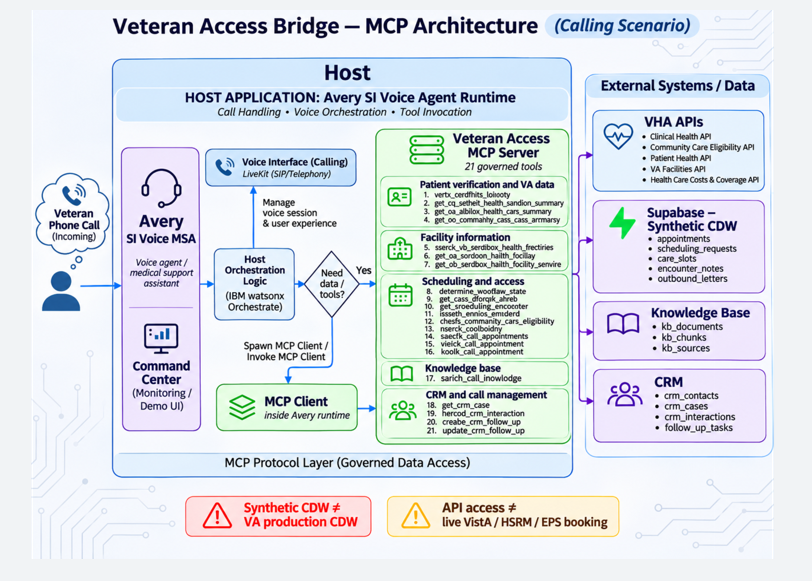
Open full-size original architecture diagram. This preserved diagram describes an earlier 21-tool calling-scenario inventory. The independently reviewed November 18 configuration had 29 registered tools when optional features were enabled, with 21 MCP attachments on Avery. Counts from different versions are not interchangeable.
What each layer does
| Component | Responsibility |
|---|---|
| Browser and LiveKit voice host | Caller audio and scoped interface. Trusted host handles verified participant/session context and current confirmation. |
| Avery · IBM watsonx Orchestrate | Conversational coordination; selects MCP tools and responds using returned evidence. |
| Veteran Access Bridge · Python FastMCP | Typed tool schemas, authentication, case/identity scope, validated requests and structured results. |
| Deterministic services | Eligibility, access standards, ranking, appointment selection, consent/policy gates, idempotent commits. |
| VHA sandbox adapters | Configured read-only government sandbox interfaces; not production VistA/HSRM/EPS booking. |
| Supabase PostgreSQL / synthetic CDW | Simulated appointment and CRM state, restricted writes, record-backed receipts. |
| Knowledge / RAG | Retrieval of supporting content; retrieved text is evidence, never authority. |
Engineering decisions
Canonical encounter data, explicit source provenance and typed tool outputs.
Eligibility and access-standard checks run in deterministic backend services.
Identity, consent, scope and booking rights cannot be issued by model prose.
Persisted receipts and independent reads distinguish a completed booking from a spoken claim.
Trust-boundary detail
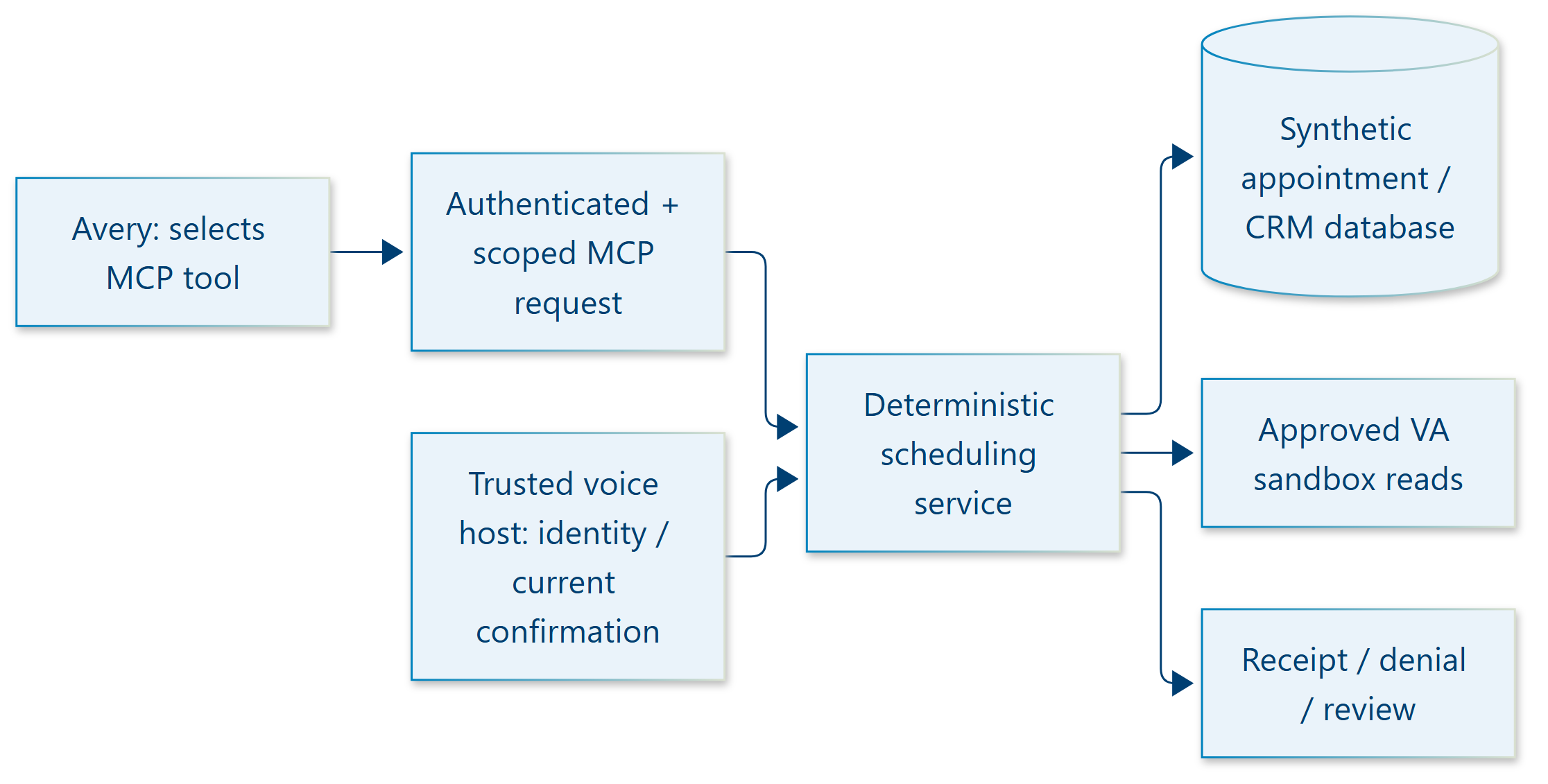
Core principle: SI can request an operation. Only trusted services determine whether it is valid, permitted and committed. Routine scoped internal Primary Care service policy and Community Care human-review paths are intentionally distinct.
Evidence
A November 16 controlled RTC call selected five IBM MCP tool types and reached one independently verified synthetic appointment, one host-written CRM note, and a BOOKED_SIMULATED receipt. This proof belongs to the recorded revision, not to an assumed later build.
Historical booking acceptance · Machine-readable evidence · MCP Implementation
Synthetic technical demonstration only. Diagram shows a historical design, not proof of production VA data access or authorization.